Station keeping
Δv envelope to stay in a LEO or GEO box
Station keeping estimates the maneuver effort to keep a spacecraft inside an operational box over a long horizon. Lifetime asks how long until uncontrolled decay. Station keeping assumes you spend Δv to stay.
Add from Mission Tree → Analysis → Station keeping.
Propagation always starts at the scenario start time. Target SMA / longitude / inclination are taken from the linked spacecraft at run — you set tolerances, not a second orbit.
Beta 0.1.0 — analytical Budget only
This study is a preliminary Δv envelope (order of magnitude), not high-fidelity closed-loop control. In Beta 0.1.0 you get:
- LEO — Altitude Control (near-circular SMA deadband + drag)
- GEO — analytical East-West / North-South (Soop-class rates, no numerical integration)
A LEO box on the ground, ground-track control, orbit-tube control, and similar operational boxes are not in Beta 0.1.0 — they come in the next build. Coupling to a propulsion tank / thruster is also later. Treat this page as the Budget slice, not the full station-keeping suite.
When to use
| Use Station keeping when… | Prefer something else when… |
|---|---|
| A first-cut LEO altitude or GEO slot Δv in Beta 0.1.0 | Natural decay life → Lifetime |
| Compare tolerances / solar levels | Coverage or RF → Coverage / Link |
| Δv envelopes for reports | One-orbit energy → Power |
What Beta 0.1.0 allows
| Regime | Control (editor) | What it holds | Method |
|---|---|---|---|
| LEO | Altitude Control only | SMA / altitude deadband | Analytical circular drag + in-plane restore burns |
| GEO | East-West, North-South, or East-West + North-South | Longitude and/or inclination windows | Analytical Soop-class deadband loop |
Not in Beta 0.1.0 (next build and later): ground-track control, orbit-tube / LEO box on the ground, periodic / LTAN channels, high-fidelity integrated deadbands, propellant mass from a thruster.
Put the spacecraft orbit already near the intended regime (LEO circular-ish, or a GEO slot). Budget LEO is near-circular: density is averaged on a circle at SMA altitude. Do not treat it as valid for a clearly eccentric LEO.
Horizon and Budget bin
The horizon is how far the envelope runs. The bin is the time step of that analytical loop — not a propellant tank, and not the scenario length.
| Field (editor) | Meaning |
|---|---|
| Analysis name | Name in the tree and Dashboard |
| Active | Off → skipped on scene refresh |
| Spacecraft | The bus under study |
| Max duration days | Length of the Budget (default years-scale; plan limits may cap it) |
| Budget bin days | How often the engine evaluates the box (default 30, minimum 1) |
Every bin the engine:
- LEO — samples mean atmospheric density on a circle of radius = current SMA (≥10 points in argument of latitude, so day/night / LST average out), then decays SMA for that bin. If SMA hits the lower deadband, it applies an in-plane circular Δv back to the correction SMA.
- GEO — advances longitude and/or inclination with the analytical rates, then checks the windows. A burn in that bin is recorded if a deadband is hit.
Smaller Budget bin days → denser Dashboard samples and slightly tighter timing of when a burn is booked. It does not change the physical rate laws (drag formula, Soop EW/NS rates). A 30-day bin is the usual monthly envelope; a 1-day bin is for a finer cadence plot, not a more “true” atmosphere.
The scenario interval in the header is the mission clock (Design). Station keeping’s horizon is independent — a 365-day Budget can run on a 12-hour scenario.
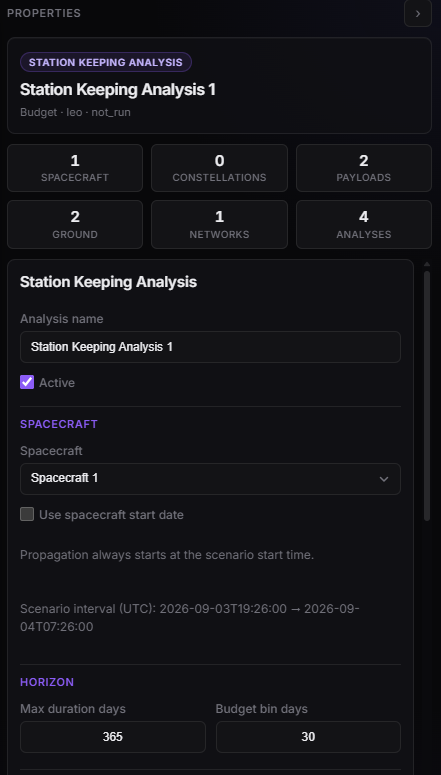
Station keeping Properties — spacecraft, max duration, Budget bin days.
Station Keeping (Budget)
The Station Keeping (Budget) block is the envelope itself. The editor states it: analytical Δv only; high fidelity is not offered in this release.
LEO — Altitude Control
Target SMA follows the spacecraft orbit (read-only). Mass, Cd, and drag area come from the spacecraft Generic tab — the same ballistic coefficient B = Cd × drag area / mass as Lifetime. Environment (atmosphere, space weather, solar activity) is LEO-only; GEO Budget does not use density.
| Field (editor) | Meaning |
|---|---|
| Regime | LEO |
| Target SMA km | From the spacecraft at run (edit the orbit to change it) |
| SMA tolerance ± km | Half-width of the altitude / SMA box (lower edge = target − tolerance) |
| Correct to upper deadband edge (target + tolerance) | Each restore aims at target + tolerance instead of the centre |
| Atmosphere / space weather / solar activity | Same idea as Lifetime. Compare All overlays Low / Moderate / High |
Tighter tolerance and edge correction ⇒ more maneuvers / Δv. Density is not sampled at perigee/apogee of an eccentric orbit.
GEO — analytical EW / NS
Slot longitude and inclination come from the spacecraft at analysis start (read-only). You only set the windows.
| Strategy (editor) | What you hold |
|---|---|
| East-West | Longitude window (Longitude tolerance ± deg) |
| North-South | Inclination window (Inclination tolerance ± deg) |
| East-West + North-South | Both — the usual GEO slot story |
| Channel | When the window is hit |
|---|---|
| North-South | Inclination burn, then reset to the spacecraft target (returns to centre) |
| East-West | Reverse longitude drift and clamp to the edge of the window (does not return to slot centre) |
Tighter boxes ⇒ more Δv. Combined is the usual GEO product. This is not a numerically integrated GEO box — it is the Soop-class envelope.
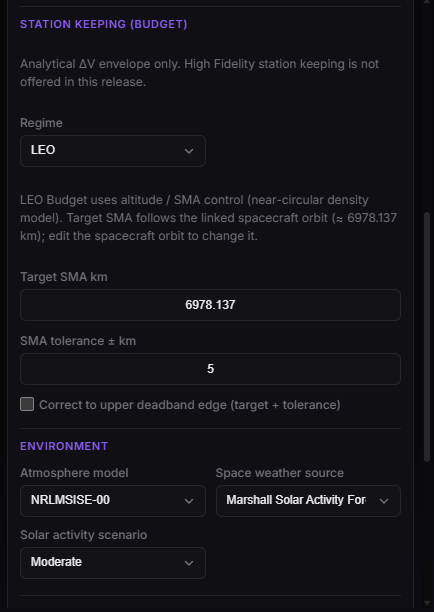
Station keeping (Budget) — regime, LEO SMA deadband, atmosphere (LEO); GEO strategies appear when Regime is GEO.
After Run
Dashboard: select this Station keeping analysis → cumulative / instantaneous Δv, maneuver cadence. LEO also has SMA / altitude / density; GEO has longitude, inclination, and the control box. Compare All (LEO) overlays Low / Moderate / High on the same cumulative-Δv plot.
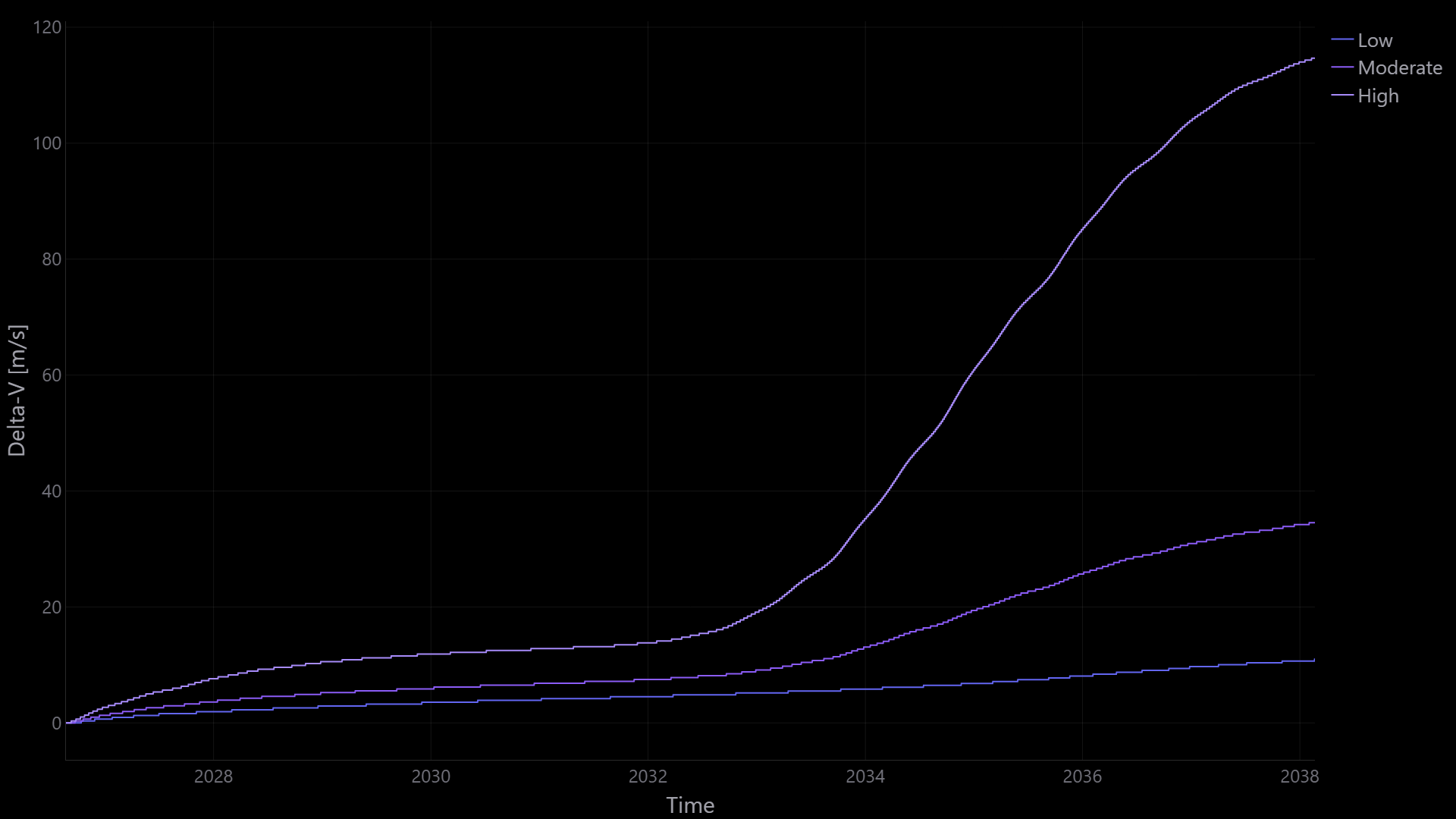
Dashboard — cumulative Δv vs time, Low / Moderate / High solar activity (Compare All).
High Δv — tight tolerances, strong drag / solar activity, Correct to upper deadband edge.
Sparse maneuvers — loose deadbands; check they still match operations.
GEO control box looks lattice-like — expected for Budget EW edge-bounce; not a high-fidelity Lissajous.
Stale — spacecraft orbit, Generic mass/Cd/area (LEO), or these fields changed.