Connection network
Declared mesh, then access on each edge
A connection network is the operational graph: which nodes are allowed to talk. After you declare edges, a run computes geometric access on each edge. Routing and Latency do not invent contacts — they walk these windows.
This is not a one-off Link pair. It is the architecture: bent-pipe, ISL mesh, or hybrid.
Plan cap for how many networks you may add is separate from other analyses.
When to use
| Use a Connection Network when… | Prefer something else when… |
|---|---|
| You will run Routing or Latency | One pair only → Link |
| ISL meshes, several gateways, bent-pipe | Area metrics only → Coverage |
| Constellation All Satellites as a graph node | You are still closing a single RF hop |
How to build it
- Add the analysis; name it.
- Under Connections, add rows From → To. Ends can be spacecraft, vehicles, facilities, targets, sensors, or constellation All Satellites / All Sensors.
- Analysis Interval and Access Sampling (step).
- Apply Changes, then Run Analysis. Aggregates expand to members; every concrete pair on an edge is tested.
- Drawing an edge does not bypass constraints (elevation, eclipse, …).
Keep the graph small: every edge is an access computation over the whole interval.
| Pattern | Typical edges |
|---|---|
| Bent-pipe | Spacecraft (or sensors) → facilities; no ISL |
| ISL mesh | Spacecraft–spacecraft (or constellation aggregate) plus downlinks |
| Hybrid | Sparse ISL + several gateways |
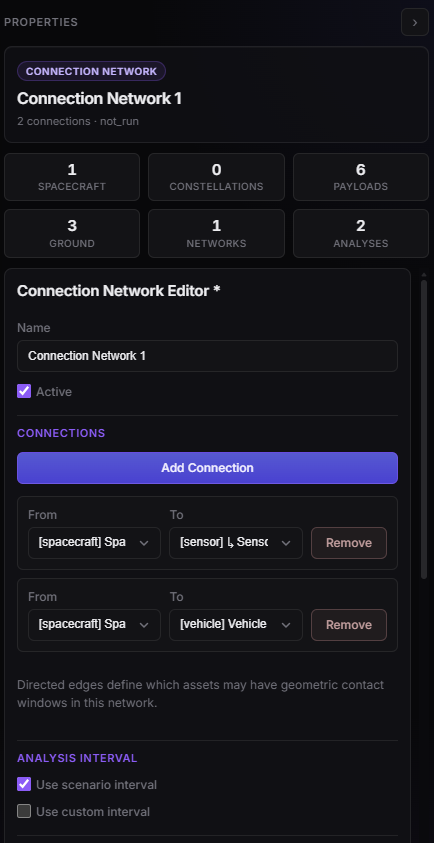
Connection network — from/to rows and sampling step.
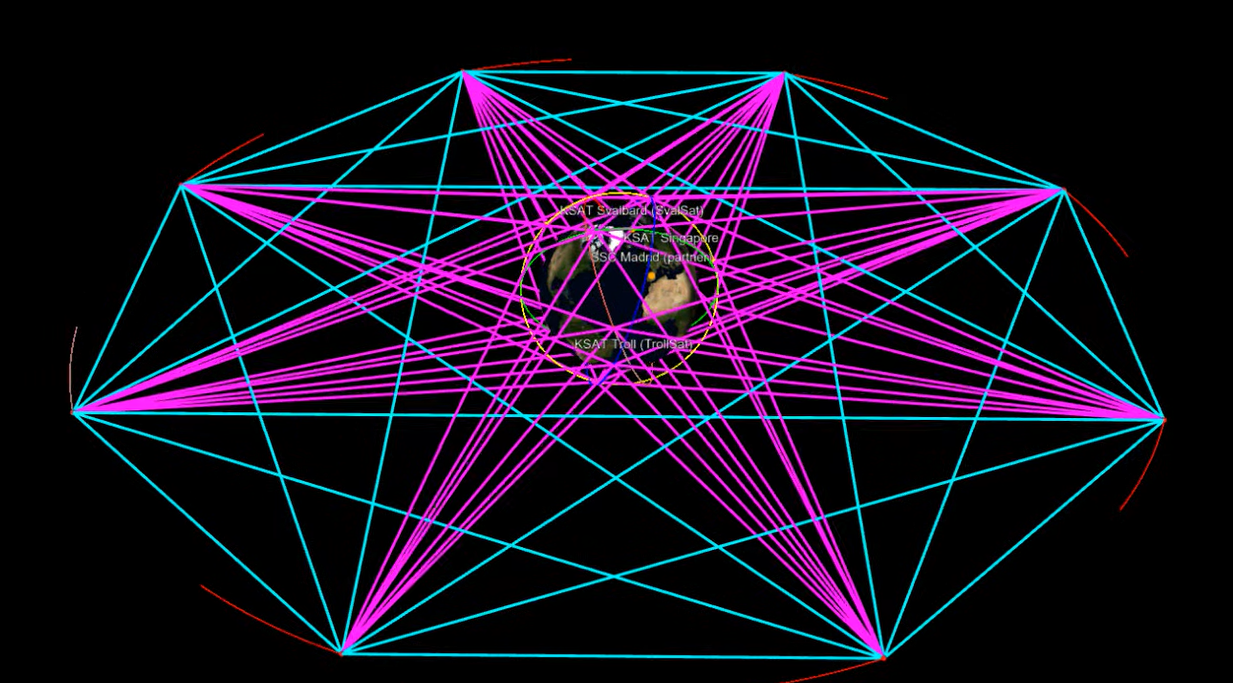
Design — access lines on declared edges after Run.
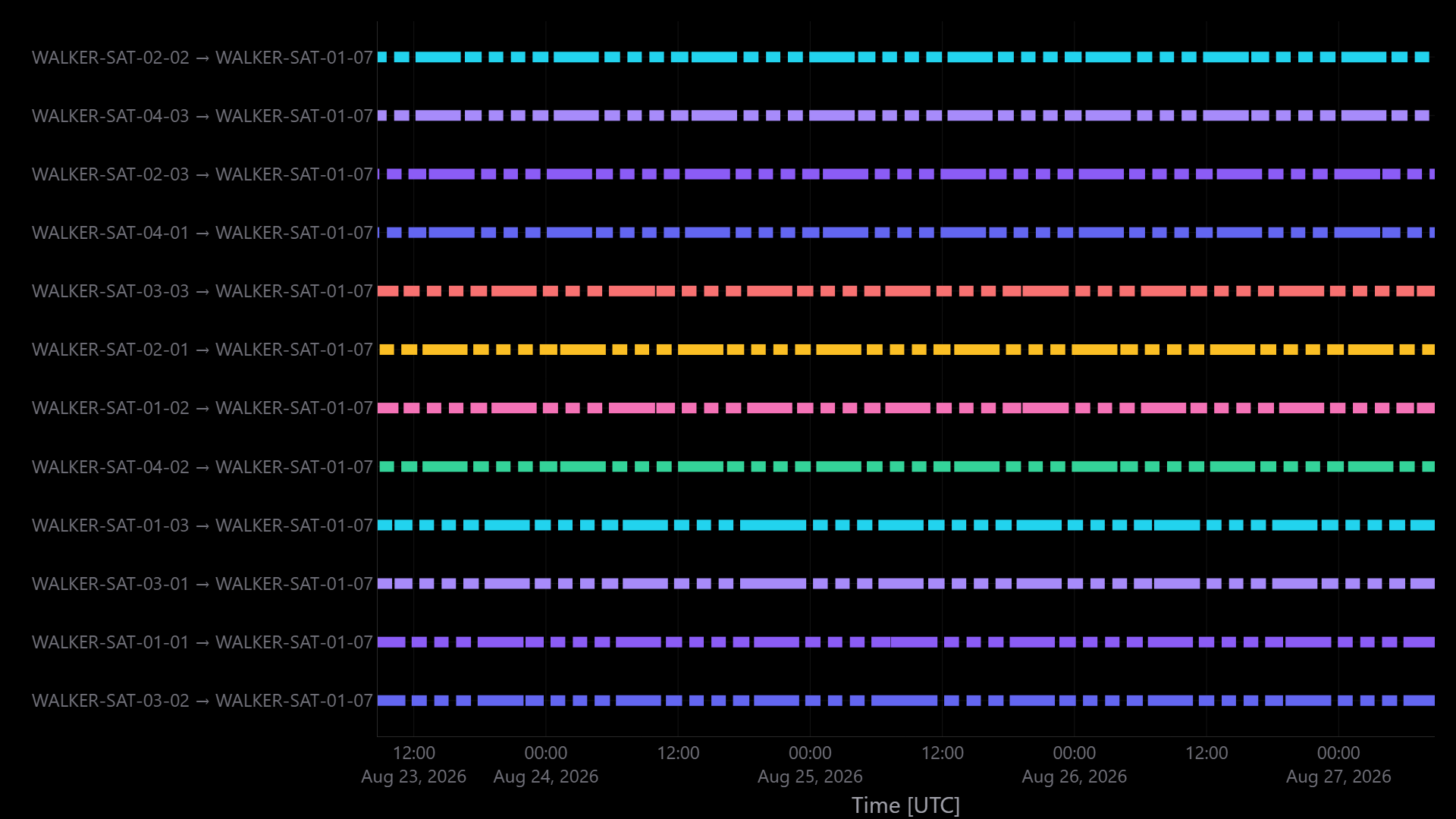
Dashboard — access windows on each declared edge.
After Run
Apply Changes redraws stored graphics. Run Analysis recomputes after topology or Access Sampling / interval changes. Dependent Routing and Latency studies become stale when the network changes.
Need both From and To set; self-loops only for constellation aggregates with at least two members.
Empty lines: horizon, elevation, eclipse, inactive nodes, or an edge that was never geometrically true in the interval. Drawing the edge does not grant contact.