Routing / Path
Unique feasible strands from A to B
Routing does not invent a mesh. It reads a completed Connection Network and lists the unique strands that can actually connect a source (A) to a target (B) during the interval — multi-hop sequences whose edges are geometrically true at the same time.
Think of it as a derivation of the network: the Connection Network answers “which links are allowed, and when do they have access?” Routing answers “which distinct A→B routes exist on that graph?” It does not size payloads, store-and-forward queues, or RF margin — that is Latency or Link.
This Beta enumerates feasible unique strands. It does not yet rank or pick an optimum.
Add from Mission Tree → Analysis → Routing.
When to use
| Use Routing when… | Prefer something else when… |
|---|---|
| You need the set of possible A→B paths on an existing mesh | Declaring which edges exist → Connection network |
| You want unique hop sequences (bent-pipe vs ISL vs hybrid) | One pair’s visibility / RF → Link |
| You will later attach Latency on that same network | Time-to-ground with data rates → Latency |
Editor
Complete the Connection Network first, then set:
| Field (editor) | Meaning |
|---|---|
| Routing ID | Name in the tree and Dashboard |
| Active | Off → skipped on scene refresh |
| Network | The completed Connection Network to walk |
| Source Asset | Endpoint A (must appear on that network). Constellation aggregates also need Select member. |
| Target Asset | Endpoint B (same rules as source) |
| Apply connection-network directionality | Honour each edge as From→To only. Off treats contacts as undirected for path search. |
| Max hops | Longest strand allowed (default 8). Larger values explode the search. |
| Interval | Scenario window (usual) or a custom UTC range |
| Show strands | Draw feasible strands in Design after Run |
| Line color / width | Graphics only — does not change which strands exist |
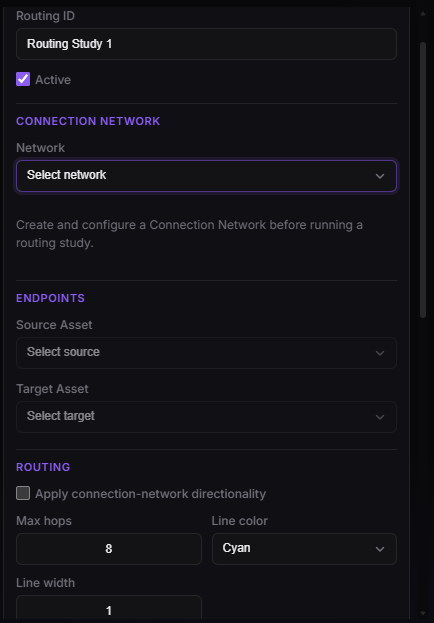
Routing Properties — network, source, target, max hops.
Apply Changes redraws stored strands. Run Analysis recomputes after the network or these fields change.
No strands — missing edges, no overlapping access, endpoints not on the graph, Max hops too small, or directionality blocking the reverse hop.
Stale — the Connection Network changed; run Routing again.
Later builds
Enumeration of unique strands is the foundation. Later Beta builds will add optimal and ranked strands on the same A→B question, including:
- K-path — the K best distinct alternatives, not only “does a path exist?”
- Optimal by hop count — fewest relays
- Optimal by total range — shortest accumulated slant-range along the strand
Until then, read Routing as the catalogue of possible unique strands, not as a traffic engineer picking one.